Artificial intelligence in insole manufacturing
How students at Heilbronn University are working with pedcad on the future of orthopedics pedcad foot technology GmbH was born out of an experienced orthopedic shoe technology company and the vision of making insole manufacturing digital and intelligent. Today, pedcad is one of the leading providers of measurement, software, and manufacturing systems for the production of custom insoles. In cooperation with Heilbronn University, two theses were written that show how practical research is driving the digitalization of orthopedic technology. Under the supervision of Prof. Dr. Alexander Windberger and Prof. Dr. Alexandra Reichenbach, two students developed AI-based systems that will take over important steps in the analysis and design of digital insoles in the future. We would like to express our sincere thanks to both professors for their excellent cooperation, their technical support, and the inspiring exchange throughout the entire project phase.
Automatic foot type determination based on pressure measurement data
Bachelor's thesis by Nina Stegmayer – Heilbronn University, Institute for Artificial Intelligence
Precise determination of foot type forms the basis for the individual adaptation of orthopedic insoles. Until now, this assessment has been carried out manually by specialists who evaluate
pressure measurement images and use their experience to decide whether, for example, a person has high arches, splayfoot, or flat feet. This process requires extensive specialist knowledge and is
time-consuming, especially when dealing with large amounts of data or limited human resources.
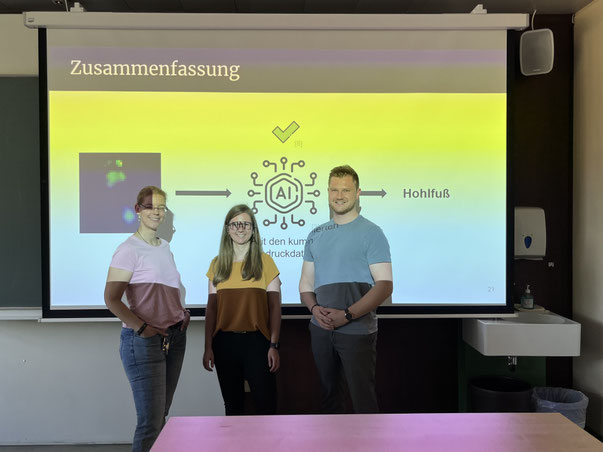
The aim of Nina Stegmayer's bachelor's thesis was to automate this step using an AI-based process, making it more objective, faster, and more reproducible. The project was based on over 1,000
real foot pressure measurements provided by pedcad. These pressure images show the load distribution of the foot and make it possible to identify characteristic differences between different foot
types, such as the shape of the longitudinal arch, the pressure distribution in the midfoot, or the symmetry of the load.
An image classification model was developed and trained based on this data. The artificial intelligence analyzes the pressure distribution, recognizes recurring patterns, and assigns the image to
one of five predefined classes: hollow foot, slight hollow foot, splayfoot, flat-splayfoot, or flat foot. The learning process is based on the principle that AI learns from numerous examples to
identify subtle differences between foot types and assign them reliably.
After completing the training, the model achieved a classification accuracy of around 83%. This successfully demonstrated that artificial intelligence is capable of automatically detecting foot
deformities with a high degree of reliability. At the same time, the work showed that the quality and consistency of the training data have a decisive influence on the accuracy of the results. A
standardized database and the involvement of several experts in the labeling process are therefore essential factors for the further development of the system.
In the long term, the developed solution will be integrated into the pedcad software environment. This will enable foot type determination to be carried out automatically in the future without
the user having to provide additional information. The system delivers objective, reproducible results, thereby laying the foundation for more efficient, standardized insole design: another step
toward fully digitized care processes in orthopedic technology.
Segmentation of anatomical foot areas for insole design
Master's thesis by Mohammad Alkassab – Heilbronn University & Heidelberg University
While Nina Stegmayer focused on the automatic determination of foot type, Mohammad Alkassab dealt with the precise segmentation of anatomical foot areas. The aim of his master's thesis was to
develop an AI-based solution that automatically divides the foot into functionally relevant segments on 2D scans and pressure measurement images. This segmentation forms the basis for the digital
and anatomically accurate design of insoles in the future.
More than 1,000 real 2D foot scans and pressure measurement data from the pedcad data pool were available for the project. To train the models, the data sets were first annotated manually.
Experts marked 24 defined key points that represent characteristic anatomical regions of the foot: from the big toe to the transverse and longitudinal arches to the heel. These points served as a
reference for the AI to independently recognize the position and shape of the individual foot areas.
The developed system analyzes the contours and pressure distribution of the foot and uses this information to derive the spatial structure of the segments. For example, it clearly distinguishes
between the forefoot, midfoot, and rearfoot, and can also take asymmetrical or individual deviations into account. Based on this data, the system automatically generates precise segment
boundaries that can be further processed for digital insole design.
The results are remarkable: the model achieved an average deviation of only about one percent of the image diagonal. This value is considered highly accurate in image processing. In addition,
Alkassab developed a method for transferring the segmentation information obtained from 2D scans to pressure measurement data. This allows areas that are not fully captured in the pressure
measurement due to low load, such as the toe region, to be supplemented.
For practical application, a standalone software tool with a graphical user interface was developed that visually displays the segmentations. It allows both automatic AI evaluation and manual
post-processing by specialist users. The exported segment data can be integrated directly into the pedcad design software, enabling automated, anatomically sound insole production.
This work has created a central technological basis for integrating AI-supported segmentation processes into digital orthopedic technology and making insole design more efficient, standardized,
and reproducible in the future.
Merging both systems – AI as a tool for modern orthopedic technology
Both projects mesh seamlessly:
- Nina Stegmayer's foot type determination provides a sound, AI-based diagnosis.
- Mohammad Alkassab's segmentation accurately identifies anatomical structures.
Together, they enable a fully automated analysis process in which diagnosis and design parameters are generated directly from the scan. The manual step previously required, in which pedoffice
users had to enter the foot type and diagnosis, will be completely eliminated in the future.
This opens up a new level of efficiency for orthopedic companies: The software not only provides measurement data, but also the appropriate analysis directly. Specialists can build on this and
customize their own insole shape in a targeted manner: similar to placing a pad, only much more precisely and quickly.
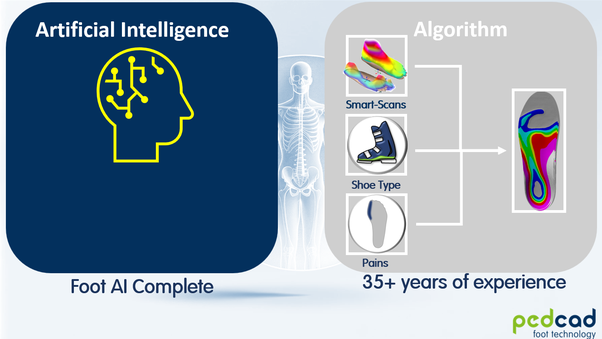
The integration of both systems creates a workflow at pedcad in which humans and AI work together intelligently. The AI runs exclusively on the pedcad servers, automatically analyzes the
measurement data, and makes the results available directly in the software.
This brings pedcad a decisive step closer to its goal of completely digitizing and standardizing insole production and demonstrates how technological innovation and craftsmanship expertise can
work together to shape progress in orthopedic technology.